Archive for December 2025

When OEM Support No Longer Fits (Rethinking Support & SLA Models) | December 23rd, 2025

Reasons to Shift from Original Equipment Manufacturer (OEM) to Worldwide Services (WWS) in Access Networks.
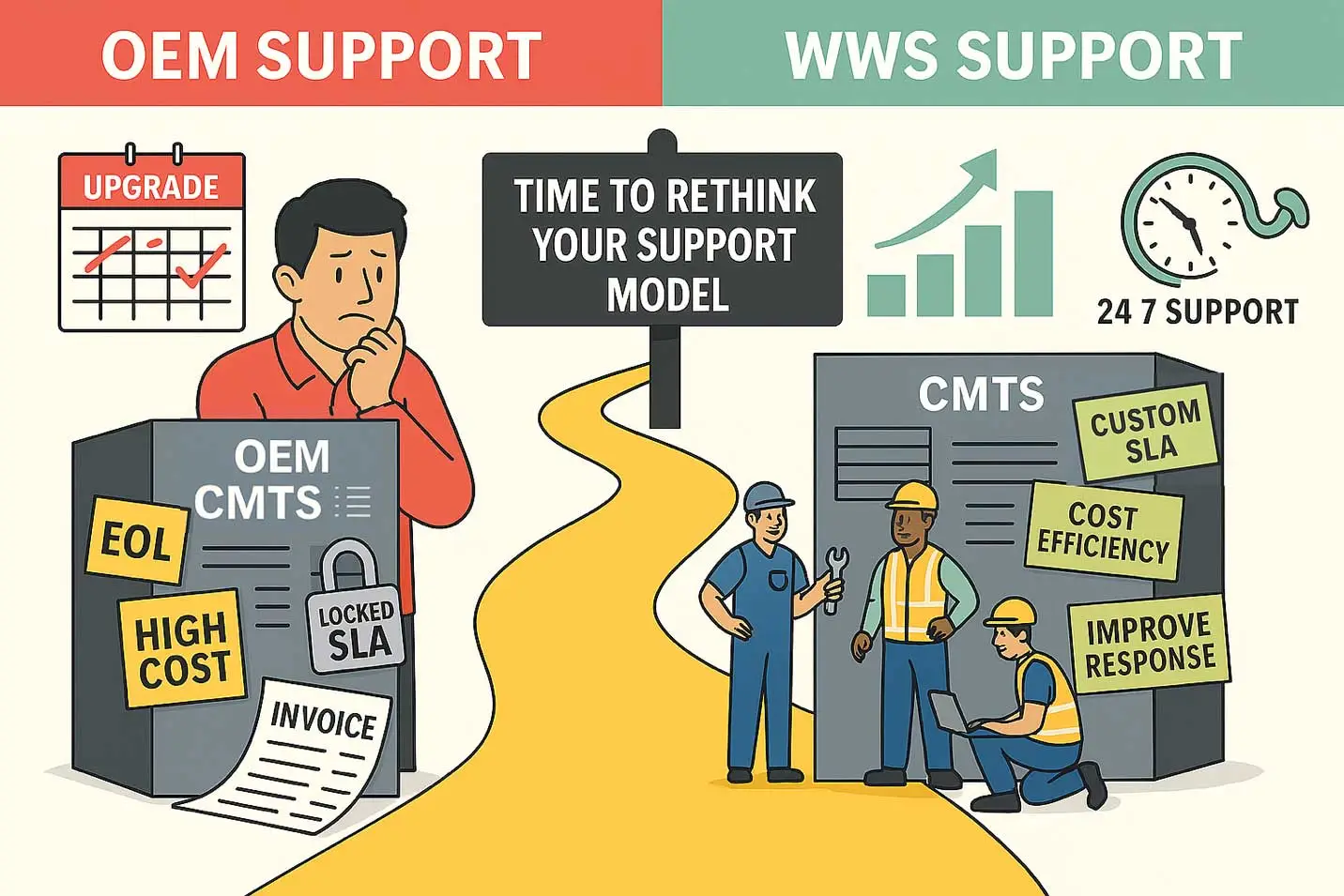
Service providers of all sizes depend on CMTS platforms and legacy video infrastructure to ensure reliable network access and content delivery, from broadband connectivity to linear TV distribution. For any operator, maintaining these systems in optimal condition is critical: a well-performing access network supports service continuity and customer satisfaction, while equipment failures can lead to significant service disruptions.

Maintaining CMTS and legacy video infrastructure involves a variety of activities, including inspections, hardware replacements, firmware management, and emergency repair services. Typically, operators rely on the Original Equipment Manufacturer (OEM) for this support, especially when hardware is still under warranty. However, this is not always the most cost-effective or flexible approach, especially when dealing with End-of-Life (EOL) equipment.

Fortunately, alternative solutions exist. Worldwide Services (WWS) offers a viable option to support your CMTS and video platforms. WWS services can reduce operational costs, offer tailored SLAs aligned with your network priorities, and extend the usable life of your installed base, contributing to both financial efficiency and sustainability goals.

If you’re encountering the following challenges, it may be time to rethink your support strategy for access and video infrastructure:

#1: Rising OEM Support Costs Are Straining Your Budget

Support contracts with OEMs like CommScope, Casa, Cisco or other legacy vendors often come with high annual costs, especially as equipment ages. These rising expenses can strain OPEX budgets, particularly when applied to mature platforms, like CMTS and legacy video, that no longer evolve but remain critical for service delivery.

#2: Our Equipment Has Been Phased Out by the Manufacturer (EOL or EOS)

Many CMTS systems and video platforms are now considered EOL or EOS by the manufacturer, meaning no new software updates or official support is available. Yet these systems may still be operationally solid and capable of delivering quality service with the right maintenance strategy.

#3: Standard OEM SLAs Don’t Match Your Operational Needs

OEM support can sometimes be rigid, with limited options to customize SLAs based on your network’s criticality or geography. Worldwide Services offers more agile support models, including 24/7 on-site assistance, local hardware stock, and tailored response times that match your operational needs.

#4: You Need Greater Autonomy Over Infrastructure Lifecycle Planning

With OEM-driven strategies, decisions about upgrades or replacements are often dictated by the vendor’s roadmap, not your network’s reality. WWS allows engineering teams to retain control over how long CMTS and video platforms stay in production, reducing forced migrations and aligning lifecycle decisions with actual service needs.

Is It Time to Make the Switch?

As access network infrastructure continues to age, relying on OEM support can become increasingly expensive, inflexible, and misaligned with your operational priorities. Ultimately, upgrade and refresh cycles tend to benefit the manufacturer, not the operator.

Worldwide Services (WWS) offers a smart and practical alternative to traditional OEM support for CMTS and legacy video platforms.

By switching to WWS, operators can achieve significant cost savings, extend the service life of critical network elements, gain access to tailored support models, and retain control over technology lifecycle decisions.

Take a close look at your current OEM contracts and assess whether they still serve your access network’s needs. If not, WWS could help you extract more value from your existing infrastructure, reduce operational expenses, and build a more sustainable, efficient support model.


read more

2025 Network Infrastructure Trends: What CIOs Can’t Afford to Ignore | December 15th, 2025

The pace of change in enterprise networking has always been fast, but 2025 is shaping up to be a turning point. CIOs face rising operational demands, more remote connectivity, and constant security pressures. The key question: How should networks be designed, supported, and scaled in this environment?

This year, organizations are moving away from “bigger and newer” and toward smarter, flexible strategies that optimize what’s already in place. Here are the top trends CIOs need to know.

Why is lifecycle extension becoming a strategic priority for CIOs in 2025?

Lifecycle extension is critical because CIOs face tighter budgets, hardware shortages, and shorter vendor support windows. Extending the life of existing infrastructure reduces unnecessary spending and stabilizes operations in unpredictable environments.

CIOs should consider:

●      Which assets truly need upgrading

●      Which can be optimized or supported longer

●      How to make refresh cycles more intentional

How can CIOs integrate sustainability into network infrastructure?

Sustainability is no longer optional. Rising e-waste and regulatory pressure mean IT teams must adopt greener practices.

Practical steps include:

  • Extending hardware lifespans
  • Responsible decommissioning and recycling
  • Using refurbished or certified pre-owned equipment
  • Reducing forced refresh cycles

This approach lowers environmental impact while supporting financial and operational goals.

What does hybrid network architecture mean in 2025?

Hybrid networking now goes beyond cloud + data center. Modern hybrid networks integrate:

  • Cloud connectivity
  • Edge computing
  • On-premise systems
  • Legacy equipment that still performs well

CIOs are no longer choosing “cloud vs on-prem”; instead, they are blending both intelligently to create resilient, flexible environments.

Why is third-party maintenance becoming mainstream?

High OEM support costs and aggressive End-of-Life (EoL) schedules are pushing CIOs toward third-party maintenance (TPM).

TPM provides:

  • Predictable support costs
  • Coverage across multiple OEMs
  • Extended lifecycle support
  • 24/7 engineering availability

For many enterprises, TPM has become a key component of business continuity while freeing up budget for performance-focused modernization.

Why is network resilience more important than raw speed?

Downtime costs more than ever, so CIOs are prioritizing resilience over speed.

Key measures include:

  • Redundancy across sites
  • Improved monitoring and analytics
  • Incident response planning
  • Preventive maintenance to reduce unplanned outages

Reliable networks now drive mission-critical business continuity.

Why is field engineering and on-site support still valuable?

Even with growing automation, physical infrastructure requires hands-on expertise, especially in distributed environments.

Skilled field engineers support:

  • Installations and hardware replacements
  • Moves, adds, and changes
  • Troubleshooting complex systems

They bridge the gap between aging hardware and evolving network demands, ensuring stability during modernization efforts.

Frequently Asked Questions (FAQs)

Q: What is lifecycle extension in IT infrastructure?
 A: It’s the practice of optimizing and maintaining existing hardware longer instead of replacing it, saving costs and reducing downtime.

Q: Why is sustainability important for IT networks?
 A: Sustainable practices reduce e-waste, comply with regulations, and align financial and operational efficiency with environmental responsibility.

Q: What is hybrid networking?
 A: Hybrid networking integrates cloud, edge, on-premise, and legacy systems to create a flexible, resilient network environment.

Q: What are the benefits of third-party maintenance?
 A: TPM offers predictable costs, extended support for multiple OEMs, and 24/7 engineering, improving business continuity.

The Path Forward for CIOs in 2025

The trends point to sustainable, flexible, and budget-conscious networking. CIOs who embrace lifecycle planning, hybrid architecture, and smarter support models will lead resilient, efficient, and future-ready IT environments.

To explore lifecycle services, sustainable network strategies, and maintenance solutions that support long-term infrastructure goals, visit worldwideservices.net.

read more

The Role of Refurbished Equipment in Building a Sustainable IT Strategy | December 01st, 2025

Sustainability has become more than a buzzword in IT. It’s now a measurable objective, one that businesses are expected to consider in every technology decision. As hardware refresh cycles accelerate and OEM support windows shrink, organizations are realizing that constant upgrades aren’t just expensive, they’re wasteful.

That is why refurbished and certified pre-owned (CPO) equipment is gaining traction as a strategic pillar in modern IT planning. Rather than thinking of refurbished gear as a temporary fix, many IT teams are embracing it as a long-term, environmentally responsible, and financially practical approach to building resilient infrastructure.

Beyond Cost Savings: A Shift Toward Smarter Resource Use

Refurbished hardware has long been associated with budget-conscious operations. And while cost reduction is still a major advantage, the conversation has shifted. Today, organizations are evaluating CPO hardware for what it really offers: a way to extend the life of existing systems, reduce e-waste, and avoid unnecessary manufacturing impacts.

Every router, switch, or server that stays in service longer directly lowers the environmental cost of producing new hardware. At scale, this makes a measurable difference in both carbon footprint and resource consumption.

Worldwide Services’ refurbishment and lifecycle programs emphasize this principle, retaining value, minimizing waste, and helping organizations avoid the constant churn of hardware replacements.

How Refurbished Hardware Fits Into a Sustainable IT Roadmap

Building a sustainable IT strategy isn’t about slowing innovation. It’s about choosing smarter pathways to the same goals. Refurbished hardware plays a critical role in several areas.

Many organizations use CPO equipment to maintain operational consistency. Instead of replacing entire systems when a single part reaches end-of-support, teams can source refurbished modules or components that keep their existing architecture intact. This reduces downtime, avoids disruptive redesigns, and preserves the value of infrastructure already deployed.

Certified pre-owned hardware also supports long-term planning. By supplementing aging platforms with reliable parts, organizations can extend their use until they are truly ready for a measured, intentional upgrade, rather than one dictated by OEM deadlines.

Balancing Innovation With Responsibility

A sustainable IT strategy doesn’t eliminate new technology, it makes room for it. By extending the useful life of existing hardware, businesses free up budget and reduce operational pressure. That flexibility can then be redirected toward strategic initiatives like cloud adoption, security modernization, and automation.

Looking Ahead

As the IT landscape continues to evolve, sustainability will play an even larger role in decision-making. Refurbished equipment isn’t a compromise, it’s a strategic tool that helps organizations stay efficient, environmentally responsible, and financially prepared for the future.

To explore refurbished hardware options, lifecycle support, and maintenance programs that align with sustainable IT initiatives, visit worldwideservices.net and worldwidesupply.net.

read more

Always Supporting The Leading Technology Brands